
Core Capabilities of Modern Flight Planning Services

To choose the right flight planning platform for your aircraft, evaluate your primary mission profile, verify type-specific Pilot’s Operating Handbook (POH) aerodynamic and fuel-burn data, and ensure seamless airspace compliance and ATC filing integration. Single-engine general aviation operations prioritize intuitive weight and balance verification and offline navigation charts, while multi-engine turbine and corporate jet operators require dynamic runway analysis, custom fuel biasing, and direct Eurocontrol IFPS or FAA Center Host connectivity. Selecting the right modern flight planning services ensures accurate flight profiles, reliable reserve fuel management, and strict regulatory adherence across every route.
High-performance planning suites rely on expansive global navigation databases containing over 24,000 airports, updated strictly along the 28-day Aeronautical Information Regulation and Control (AIRAC) cycle. Similarly, some platforms incorporate over 111,000 aeronautical charts across 160 countries to ensure total navigation accuracy.
A comprehensive platform automates routine calculations while surfacing critical operational constraints, such as runway length limits, climb gradient requirements, and weight and balance envelopes.
| Feature / Capability | Basic General Aviation Platform | Corporate & Jet Charter Solution | Airline & Global Dispatch Suite |
|---|---|---|---|
| Aircraft Profiles | Generic climb, cruise, and descent tables | Type-specific aerodynamic profiles with customizable fuel burn bias | Comprehensive performance libraries spanning 450+ aircraft models |
| Runway & Obstacle Analysis | Static runway length and airport elevation data | Detailed obstacle analysis and graphical engine-out procedures | Dynamic SID analysis with real-time obstacle elevation constraints |
| Weather & Winds Aloft | METAR/TAF briefings with basic radar overlays | GRIB2 wind updates (NOAA/UKMO models) with graphical icing/turbulence | Predictive ETA forecasting, high-resolution nowcasting, and automated en-route re-clearing |
| Airspace Compliance | Graphical TFR depiction and basic airspace boundaries | Automated validation via Eurocontrol IFPS and domestic airway filters | Integrated route constraints, flex track generation, and RAIM/FDE prediction |
| Filing Pathways | VFR/IFR filing via Flight Service Station (FSS) networks | Direct FAA Center Host filing and European B2B connection | Direct ATC, FMS data uplink, and full operational control dispatch integration |
Aircraft Performance Profiles and Fuel Management
Accurate flight planning begins with the Pilot’s Operating Handbook (POH). Advanced platforms enforce POH loading limits to verify that the center of gravity remains within approved boundaries through every phase of flight.
A modern calculation engine accounts for dynamic aerodynamic factors, including:
- Custom Fuel Burn Biasing: Adjusting baseline burn figures for engine degradation, airframe age, or specific cruise profiles (e.g., maximum cruise thrust vs. long-range cruise).
- Climb and Descent Gradients: Evaluating Standard Instrument Departures (SIDs) and obstacle heights to confirm the aircraft can meet required climb gradients under hot-and-high conditions.
- Graphical Engine-Out Procedures: Pre-computing escape paths and single-engine climb paths to guarantee terrain clearance during a departure emergency.
- Fuel Reserve Policies: Structuring total fuel loads to encompass taxi fuel, trip fuel, 3% to 5% contingency reserves, alternate destination fuel, and final reserve holdings.
Integrated solutions pair these performance calculations with commercial logistics, offering access to contract fuel arrangements at more than 4,200 locations worldwide.
Real-Time Weather Integration and Airspace Compliance
Weather remains the most fluid variable in aviation. Modern planning software continuously parses global meteorological feeds, processing high-resolution GRIB2 wind data from the National Oceanic and Atmospheric Administration (NOAA) and the UK Met Office (UKMO) up to four times daily. These continuous updates ensure that ground speeds, top-of-descent points, and fuel burns reflect true atmospheric conditions.
Simultaneously, platforms integrate graphical Temporary Flight Restriction (TFR) overlays, Special Use Airspace (SUA) schedules, and global NOTAM feeds refreshed as frequently as every five minutes. Some solutions embed compliance logic directly into their route generation engines. This ensures that every generated airway and waypoint respects regional flow management initiatives, domestic airway closures, and Eurocontrol Integrated Initial Flight Plan Processing System (IFPS) rules before a pilot or dispatcher hits submit.
How Flight Plans Are Transmitted and Processed

Understanding the technical route your flight plan takes after generation is critical for operational control. Flight plans do not travel a single, uniform path to air traffic controllers; their routing depends on the flight rules selected, the system architecture of your planning platform, and the regulatory bodies managing the airspace. The National Business Aviation Association maintains rigorous guidance regarding authorized flight planning and flight support companies to help operators navigate these networks.
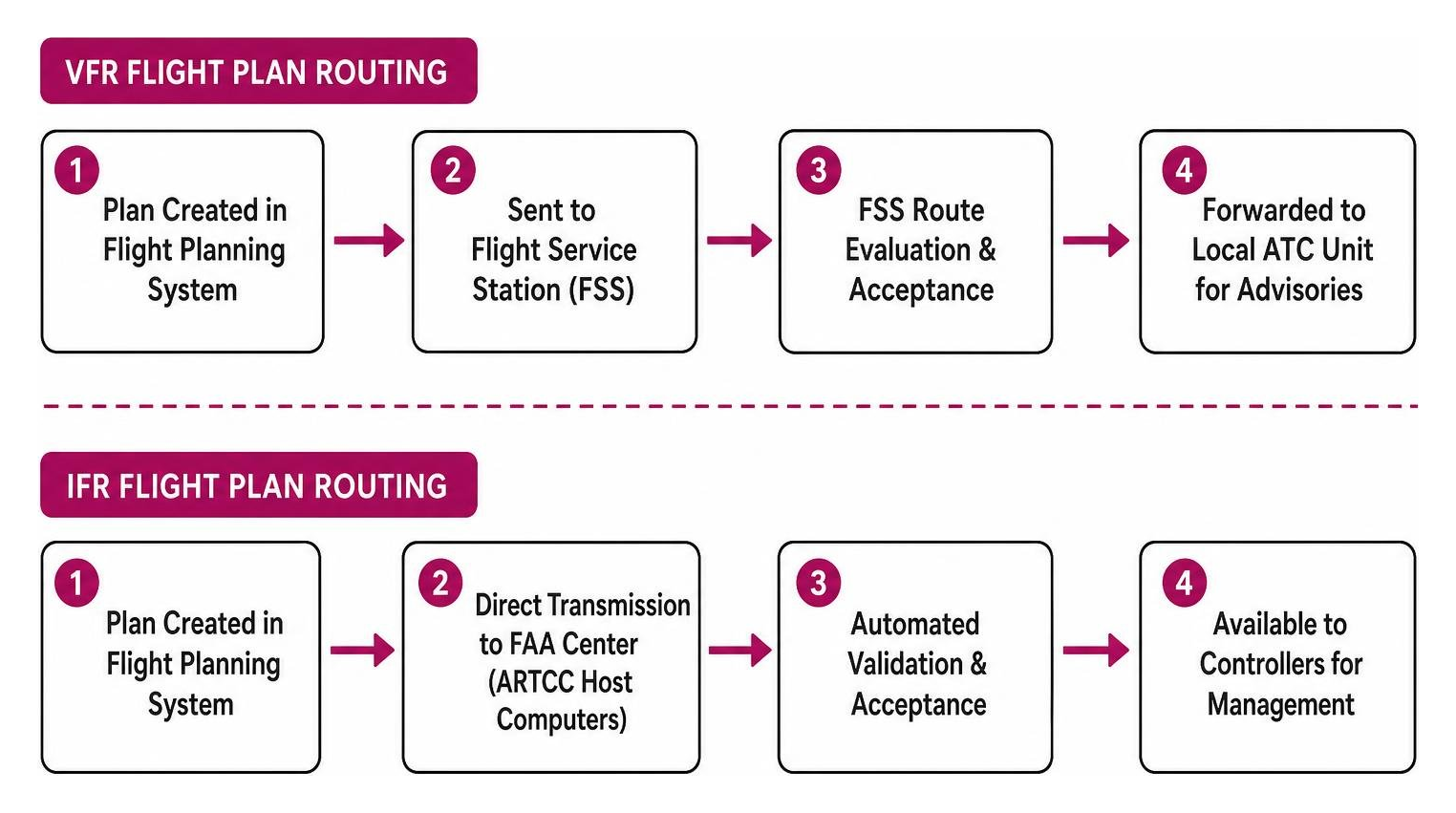
How Flight Planning Services Handle VFR and IFR Transmission
There is a fundamental operational distinction between Visual Flight Rules (VFR) and Instrument Flight Rules (IFR) plan handling in United States airspace, a distinction the Federal Aviation Administration enforces through two separate processing networks:
- IFR Flight Plans: Professional flight planning tools establish direct connections with the FAA’s Air Route Traffic Control Centers (ARTCC Host computers). When an IFR plan is filed, it feeds directly into the national air traffic automation system, generating progress strips and radar tracking data for air traffic controllers without human intermediary delay.
- VFR Flight Plans: VFR flights are primarily intended for search and rescue tracking rather than tactical air traffic separation. Consequently, modern software routes VFR plans to the FAA's Flight Service Station (FSS) network, operated by Leidos via the 1800wxbrief infrastructure. Air traffic control towers and en-route centers do not actively manage or see VFR plans until the pilot explicitly activates them with Flight Service upon departure.
Managing Multi-Leg Itineraries, ETOPS, and Oceanic Routing
When long-range flight itineraries stretch across international boundaries and oceanic tracks, flight planning moves from routine dispatching to complex mission orchestration. Advanced systems calculate Extended-range Twin-engine Operational Performance Standards (ETOPS) and Extended Diversion Time Operations (EDTO) profiles by defining precise entry points, exit points, and equal-time points (ETPs) based on designated diversion airfields.
For North Atlantic, Pacific, and Australian Flex Track systems, the software constructs compliant lateral and vertical paths that account for daily organized track structures and time-based oceanic clearances. These complex routes require seamless coordination across ground handling, customs, and fuel supply—especially when coordinating high-stakes corporate travel across major hubs such as New York, Chicago, and Los Angeles. When schedules involve demanding business commitments, integrating private aviation planning with our dedicated business travel management ensures that every passenger transfer, executive lounge arrival, and ground connection matches the precision of the flight plan itself.
Selecting the Best Platform for Your Mission and Aircraft Type

Selecting the right software begins with a clear assessment of your operational profile. A general aviation pilot flying a single-engine piston aircraft on weekend regional trips needs responsive navigation data, intuitive weight and balance verification, and simple weather overlays. In contrast, corporate flight departments and turbine operators demand dynamic runway analysis, multi-leg crew duty tracking, and automated passenger manifest synchronization.
When organizing high-touch family getaways or group vacations, our tailored leisure travel planning pairs private aviation routing with curated ground experiences, luxury accommodations, and private transfers across premier destinations from Miami and Palm Beach to Scottsdale and Newport Beach.
Specialized Flight Planning Services for Private Jets vs GA
The operational gap between general aviation (GA) and private turbine operations centers on compliance complexity, payload margins, and ground coordination:
- Runway Performance and Fleet Scalability: Piston pilots often rely on static chart interpolations. Jet operators require dynamic runway analysis that calculates balanced field lengths, accelerate-stop distances, and clearway margins based on live temperature, pressure altitude, and runway contamination reports.
- Passenger and Operational Workflow: High-end flight departments use integrated enterprise systems to link flight planning directly with maintenance tracking, crew duty limits, and passenger itineraries.
- FBO Coordination and Handling: Jet planning involves coordinating Fixed Base Operator (FBO) ramp handling, fueling orders, and hangar arrangements. Whether you are landing at a private terminal in Dallas, Boston, Seattle, or utilizing premier facilities like the FBO at San Diego International Airport, planning software must coordinate operational data seamlessly with local handling agents.
International Trip Support and Third-Party Dispatch Integration
For operations flying outside domestic airspace, working with full-service flight support teams—such as licensed dispatchers or international handling networks—remains indispensable.
These dedicated teams handle logistical elements that automated platforms cannot solve alone:
- Permits and Clearances: Securing landing rights, diplomatic overflight permits, and non-scheduled commercial charter authorizations.
- Airport Slot Coordination: Managing strict arrival and departure slot windows at congested international hubs.
- Bespoke Route Feasibility: Adjusting flight routings around active geopolitical conflict zones and regional airspace closures.
- Complete Mission Support: Partnering with trip specialists ensures coordinated handling, customs pre-clearance, and ramp supervision anywhere in the world.
The Future of Flight Planning Technology
Flight planning technology is evolving rapidly, driven by artificial intelligence, cloud computing, and predictive operational analytics. Modern platforms are moving away from static pre-flight calculations toward continuous, dynamic optimization engines.
Emerging systems integrate predictive arrival forecasting powered by flight-tracking intelligence models. These systems monitor real-world taxi delays, holding patterns, and terminal airspace congestion, updating Estimated Times of Arrival (ETAs) within minutes of accuracy long before the aircraft reaches its top-of-descent point. Furthermore, direct cloud-to-cockpit Flight Management System (FMS) data uplinks allow dispatchers to push updated oceanic clearances and modified routing waypoints straight into the cockpit avionics suite over satellite datalinks.
Simultaneously, developer architectures using languages like Rust are bringing high-speed, device-side route calculation to mobile platforms. This guarantees that pilots can recalculate full aerodynamic profiles, review weather windows, and verify obstacle clearances entirely offline during unexpected diversions. You can explore more articles on private aviation trends and destination itineraries on our luxury travel blog.
Frequently Asked Questions About Flight Planning Support
How precise are estimated flight times generated by modern planning software?
Modern flight planning platforms using high-resolution forecast winds and exact aircraft performance models generate block-to-block flight times that are typically accurate within 5 to 10 minutes over a standard 2-to-3-hour flight leg. Unplanned ATC vectoring, ground taxi delays, and localized weather deviations account for the remaining operational variance.
Can flight planning software calculate routes while offline?
Yes. Modern native applications allow pilots to download complete navigation basemaps, terrain profiles, and AIRAC cycle data directly to their devices. While real-time live radar updates and automatic ATC filing require an active internet connection, route generation, weight and balance calculations, and POH performance verification can run offline inside the cockpit.
What is the difference between direct FAA filing and Flight Service processing?
Direct FAA filing transmits an IFR flight plan straight to the FAA’s ARTCC Host computer systems, where it is instantly processed for air traffic control handling and radar strip generation. Conversely, VFR flight plans are routed to the Leidos Flight Service Station (1800wxbrief) network. Flight Service holds VFR plans until the pilot opens them after departure to initiate active search-and-rescue monitoring. For more answers to common aviation and itinerary questions, visit our frequently asked questions page.
Conclusion
Choosing the right flight planning software is a fundamental operational decision that directly shapes the safety, regulatory compliance, and efficiency of your missions. From single-engine cross-country flights to transoceanic business travel, aligning your platform's capabilities with your aircraft's performance envelope ensures smooth operations on every leg.
At SA Travel Concierge, we believe that world-class travel extends far beyond the cockpit. While your flight crew focuses on precision routing, fuel optimization, and airspace compliance, our team delivers seamless, high-touch itinerary curation on the ground. We manage every detail—from private jet charters and luxury ground transportation to five-star accommodations, private aviation connections, and unforgettable local excursions—ensuring you enjoy an entirely hassle-free travel experience across New York, San Francisco, Chicago, Washington DC, and destinations worldwide.
Discover how our personalized approach can elevate your next trip by exploring our comprehensive range of bespoke travel services, or contact our travel concierge team today to start designing your custom itinerary.