
Why Strategic Bucket List Vacation Planning Beats Vague Daydreaming

Strategic bucket list vacation planning starts with three concrete actions: filter your dream trips by travel style and group dynamics, break each destination into regional tiers and high-impact experiences, and schedule bookings around realistic lead times for permits and peak seasons. This approach turns a scattered wish list into a prioritized, actionable travel roster. Instead of feeling overwhelmed by endless possibilities, you create a clear pathway from lifetime goals to confirmed flight itineraries and bespoke adventures.
Why Traditional Travel Wish Lists Fail
Traditional wish lists fail for simple reasons: they are abstract, disconnected from reality, and lack timing. An unstructured list gives you no indication of what to book next, how much to save each month, or when the optimal seasonal window occurs.
Without concrete dates or financial plans, you fall into the trap of passive saving. You might accumulate travel rewards points or set aside funds in a general account, but without a dedicated destination tied to a calendar year, those resources often get diverted. Unstructured lists also lead to itinerary overwhelm. Trying to figure out flights, private transfers, exclusive access, and high-demand permits across ten dream destinations all at once leads to analysis paralysis. As a result, years slip by, and only a tiny fraction of those lifetime goals ever materialize.
The Psychology of Defined Travel Milestones
Defining specific milestones unlocks what behavioral psychologists call the "anticipation dividend." Research consistently demonstrates that a massive portion of the joy derived from a major journey occurs during the planning and anticipation phase. When you have an anchor trip locked onto your calendar for 2026 or beyond, every week of work feels more purposeful.
Studies show that committed global travelers typically visit between 25 and 50 countries in their lifetime. However, the most rewarding journeys prioritize depth over a frantic race for passport stamps. Structuring your travel around meaningful milestones lets you pace yourself, embrace deep cultural immersion, and create unforgettable memories rather than rushing through superficial sightseeing.
How to Build and Prioritize Your Personalized Travel Roster
Creating a realistic travel plan starts with a candid audit of your preferences. Rather than adopting someone else’s viral itinerary, your roster should reflect your passions, energy levels, and preferred pacing. Engaging in thoughtful custom travel planning ensures every element matches your vision of the perfect getaway.
Filtering by Travel Style and Group Dynamics
Every travel style comes with distinct logistical requirements. A high-altitude trek across the Andes demands completely different preparation than a multi-generational retreat in the Mediterranean. When organizing your roster, filter your dream trips through the lens of who is traveling and how you prefer to explore:
- Adventure Travel: Requires peak physical readiness, specialized private guides, and strict timing for optimal weather (e.g., Mount Kilimanjaro climbs, Patagonia hikes).
- Solo Journeys: Focuses on seamless navigation, boutique accommodations, and effortless luxury in inherently safe destinations.
- Family & Multi-Generational Escapes: Demands villas with dedicated staff, private transport, and pacing that accommodates diverse age groups without transit fatigue.
- Pure Rejuvenation: Centers around five-star service, tranquil wellness retreats, and world-class luxury beach vacations where unwinding takes precedence over packed itineraries.
The 5-Layer System for Bucket List Vacation Planning
To convert grand ideas into seamless journeys, we use a 5-layer framework that breaks down abstract dreams into manageable planning steps:
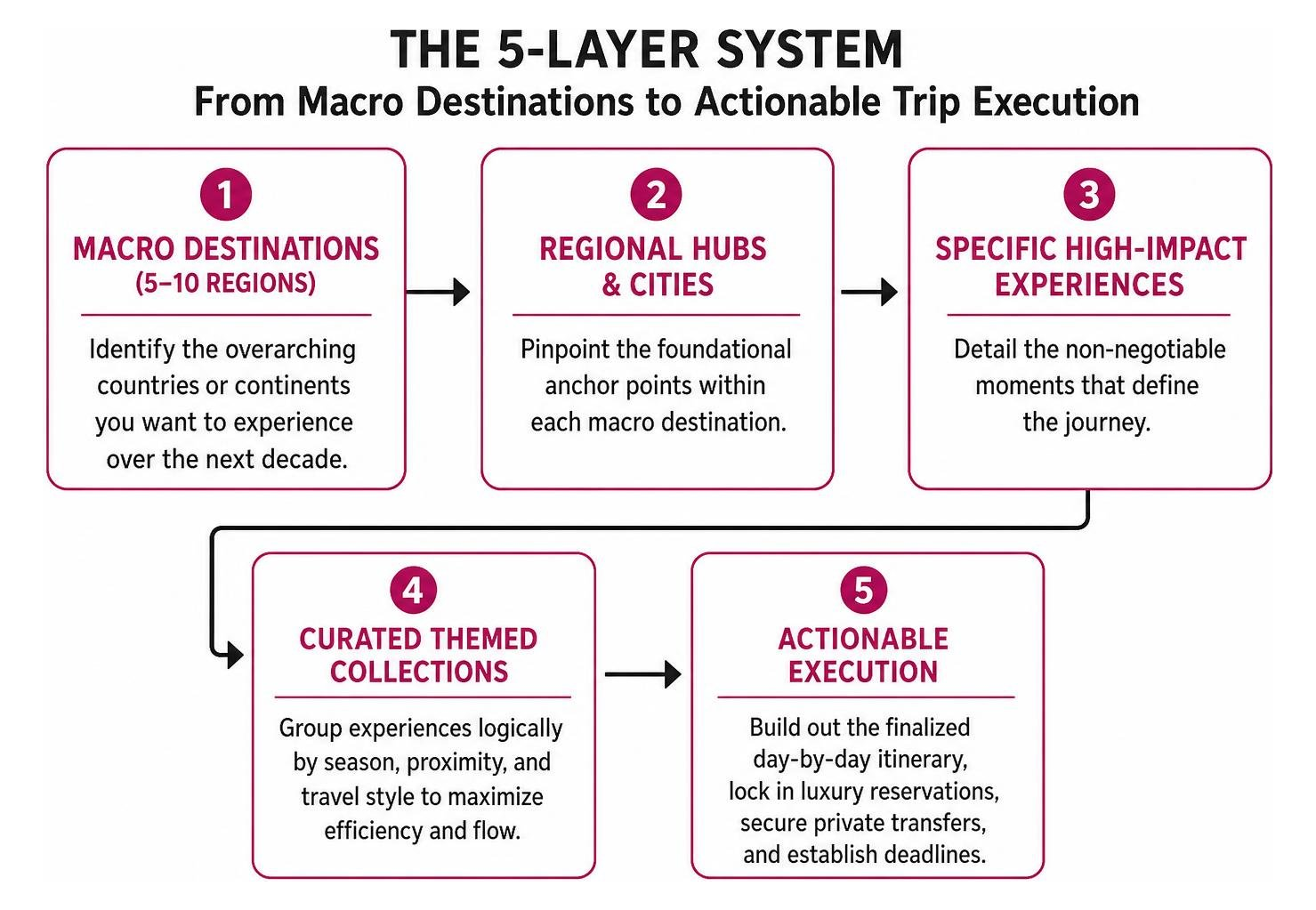
- Layer 1: Macro Destinations (5–10 Regions): Identify the overarching countries or continents you want to experience over the next decade (e.g., Japan, Southern Africa, the Swiss Alps).
- Layer 2: Regional Hubs & Cities: Pinpoint the foundational anchor points within each macro destination (e.g., Tokyo and Kyoto, or Cape Town and the Greater Kruger).
- Layer 3: Specific High-Impact Experiences: Detail the non-negotiable moments that define the journey (e.g., a private tea ceremony in an ancient Kyoto temple, or a sunrise hot-air balloon ride over the Serengeti).
- Layer 4: Curated Themed Collections: Group experiences logically by season, proximity, and travel style to maximize efficiency and flow.
- Layer 5: Actionable Execution: Build out the finalized day-by-day itinerary, lock in luxury reservations, secure private transfers, and establish deadlines.
Scoring Trips by Achievability and Urgency
Not all dream vacations should be scheduled in the same timeframe. Prioritizing your list requires evaluating physical requirements, milestone life events, and seasonal availability. Assigning an achievability score—based on budget, required lead time, and physical demand—helps identify which trips to book immediately as anchor vacations and which to stage for future years.
| Trip Category | Ideal Lead Time | Physical Demand | Primary Focus |
|---|---|---|---|
| Active Expedition (e.g., Inca Trail, Gorilla Trekking) | 9–12 Months | High | Physical endurance, strict permit access, remote logistics |
| Seasonal Cultural Peak (e.g., Kyoto Cherry Blossoms) | 9–12 Months | Moderate | Premium ryokans, high-demand dates, private cultural guides |
| Classic Wildlife Safari (e.g., Serengeti, Okavango Delta) | 8–12 Months | Low to Moderate | Exclusive private game concessions, bush aircraft, luxury camps |
| Coastal & Island Retreat (e.g., Amalfi Coast, French Polynesia) | 6–9 Months | Low | Overwater villas, private yacht charters, world-class dining |
| Boutique City Escape (e.g., Paris, London, Tokyo) | 3–6 Months | Moderate | Five-star historic hotels, VIP museum access, Michelin dining |
Practical Budgeting and Financial Strategies for High-Impact Trips
A truly transformative journey should never be overshadowed by financial stress. High-impact travel requires proactive financial planning that factors in fluctuating exchange rates and market conditions. Understanding the broader economic impacts on modern travel budgets allows you to allocate funds strategically and protect your travel investments.
Calculating True Trip Costs and Buffer Funds
A common planning mistake is budgeting only for headline expenses—flights and lodging—while underestimating the cost of premium private experiences, park fees, and exclusive access. For instance, the average cost of an African safari is around $350 per person per night for entry-level operations, while premier, all-inclusive private concessions often range from $1,000 to over $2,500 per person per night. For a family of four, even a standard five-night safari easily reaches $7,000 before factoring in regional flights and transfers.
To ensure seamless execution, calculate total trip costs using comprehensive categories:
- Long-Haul & Regional Transport: International business class, private jet charters, and scenic helicopter transfers.
- Accommodations: Luxury resorts, boutique heritage properties, or fully staffed all-inclusive luxury vacations.
- Curated Excursions & Exclusive Access: Private historians, wildlife trackers, and VIP after-hours entry.
- Dining & Gratuities: Chef’s tasting menus, private wine tastings, and premium service tipping.
- Financial Safety Buffer: A mandatory 15% to 20% contingency fund to absorb currency fluctuations, spontaneous upgrades, or unexpected logistical pivots.
Affordable Alternatives vs. Major Splurges

A well-balanced lifetime travel plan strategically pairs high-investment anchor trips with incredible value-driven destinations. You don’t need every journey to carry an ultra-luxury price tag to be unforgettable.
- High-Value Bucket-List Destinations: Countries like Vietnam ($30–$50/day base costs), Cambodia ($25–$40/day), Mexico ($40–$60/day), and Portugal ($50–$70/day) offer phenomenal culture, cuisine, and world-class scenery with unmatched value.
- Strategic Splurges: Focus your premium investments where exclusivity fundamentally changes the experience—such as private tented camps in the Masai Mara, secluded overwater villas in the Maldives, or private catamaran charters through the Greek Cyclades.
- Shoulder-Season Advantages: Visiting top-tier destinations like the Amalfi Coast, Japan, or Provence during shoulder seasons (May, September, or October) delivers pleasant weather, fewer crowds, and superior availability at premier luxury hotels.
Master the Booking Timelines, Permits, and Execution
The difference between a seamless journey and a disappointing travel setback often comes down to timing. World-renowned destinations and exclusive heritage sites maintain strict capacity limits to preserve delicate ecosystems and cultural treasures. Understanding these timelines ensures you secure your preferred accommodations, guides, and permits without compromise.
Booking Windows for Peak Season and High-Demand Permits
High-demand international travel follows predictable reservation timelines. Missing these key booking windows can delay a bucket-list dream by an entire calendar year:
- Peak Season Anchors (9–12 Months Out): Japan during cherry blossom season, Iceland in mid-summer, overwater bungalows in the Maldives for the winter holidays, and luxury Christmas getaways in the Caribbean.
- High-Demand Permits & Expeditions (6–12+ Months Out):
- Inca Trail (Machu Picchu): Strict daily trail limits require booking 6 months ahead.
- Galapagos Small-Ship Expeditions: Luxury private yachts require 6 to 9 months advance notice.
- Antarctica Fly-Cruises: Elite cabins and private fly-cruise expeditions require booking 12 to 18 months in advance for peak December departures.
- Rwanda & Uganda Gorilla Trekking: Daily habituated troop permits must be secured 6 to 12 months ahead.
- Shoulder-Season Journeys (4–6 Months Out): Wine harvesting in Tuscany, coastal road trips, and cultural tours across Southern Europe. Review our luxury Europe travel tips 2026 for optimal routing advice.
- Sophisticated City Escapes (2–3 Months Out): Weekend culinary explorations, gallery weekends, and urban cultural breaks.
Avoiding Common Mistakes in Bucket List Vacation Planning
Even seasoned travelers can fall into classic planning traps. Keeping an eye out for these frequent mistakes will ensure your journey runs smoothly:
Partnering with a seasoned luxury travel concierge eliminates these risks entirely. Dedicated planners manage complex flight connections, secure VIP airport fast-tracks, arrange private transfers, and coordinate insider access, freeing you to focus entirely on enjoying your journey.
Adapting Your Living Document Over Time
Your bucket list is a living roadmap, not a static document set in stone. As your family dynamics evolve, fitness levels shift, and new culinary or architectural passions emerge, your travel plan should adapt right alongside you.
Schedule an annual travel review every October or November to assess your upcoming year. Review your dedicated savings, check off completed milestones, re-evaluate target destinations, and adjust timelines for future anchor journeys. Treating your travel roster as an evolving life plan ensures your wanderlust consistently translates into extraordinary experiences.
Frequently Asked Questions About Dream Trip Planning
How far in advance should I book major once-in-a-lifetime trips?
For major peak-season journeys—such as luxury safaris, Antarctica expeditions, or Kyoto visits during the spring cherry blossoms—we recommend securing reservations 9 to 12 months in advance. Trips requiring specialized government permits (like the Inca Trail or gorilla trekking) should also be locked in 6 to 12 months ahead. For shoulder-season travel, 4 to 6 months is typically sufficient, while classic luxury city breaks can be arranged 2 to 3 months prior. Our dedicated travel planning services ensure every timeline and reservation is managed flawlessly.
How do I budget for a luxury bucket-list trip during economic shifts?
The most reliable strategy is to establish a dedicated travel investment fund with an added 15% to 20% contingency buffer to absorb currency fluctuations and market shifts. Balance ultra-luxury anchor trips with incredible high-value destinations, and take advantage of shoulder-season travel windows where five-star properties offer preferential rates. For more detailed financial and booking guidelines, browse our comprehensive frequently asked questions.
What are the safest bucket-list destinations for solo travelers?
The world's premier destinations for solo luxury travelers include Japan, Portugal, Iceland, New Zealand, and Switzerland. These countries combine world-class public infrastructure, exceptional safety ratings, welcoming local cultures, and intuitive navigation. They allow solo travelers to explore independently while enjoying five-star accommodations, private guided excursions, and Michelin-starred dining.
Conclusion
A lifetime of unforgettable travel doesn't happen by accident—it is created with intentionality, vision, and thoughtful execution. By transforming vague travel wishes into a structured, prioritized plan, you ensure your dream destinations become cherished memories instead of lingering daydreams.
At SA Travel Concierge, we specialize in transforming ambitious travel aspirations into perfectly orchestrated realities. Serving discerning clients nationwide from our offices in New York City, Los Angeles, Beverly Hills, Brentwood, San Francisco, San Diego, Newport Beach, Miami, Palm Beach, Dallas, Houston, Austin, Boston, Seattle, Chicago, Washington, DC, Greenwich, and Scottsdale, our team handles every detail—from private aviation and luxury villas to exclusive local access.
Ready to make your travel dreams a reality? Discover our curated leisure travel experiences and let us design your next extraordinary escape.