
Top Corporate Booking Platforms and Specialists Reviewed
Choose the Right Corporate Trip Management Service

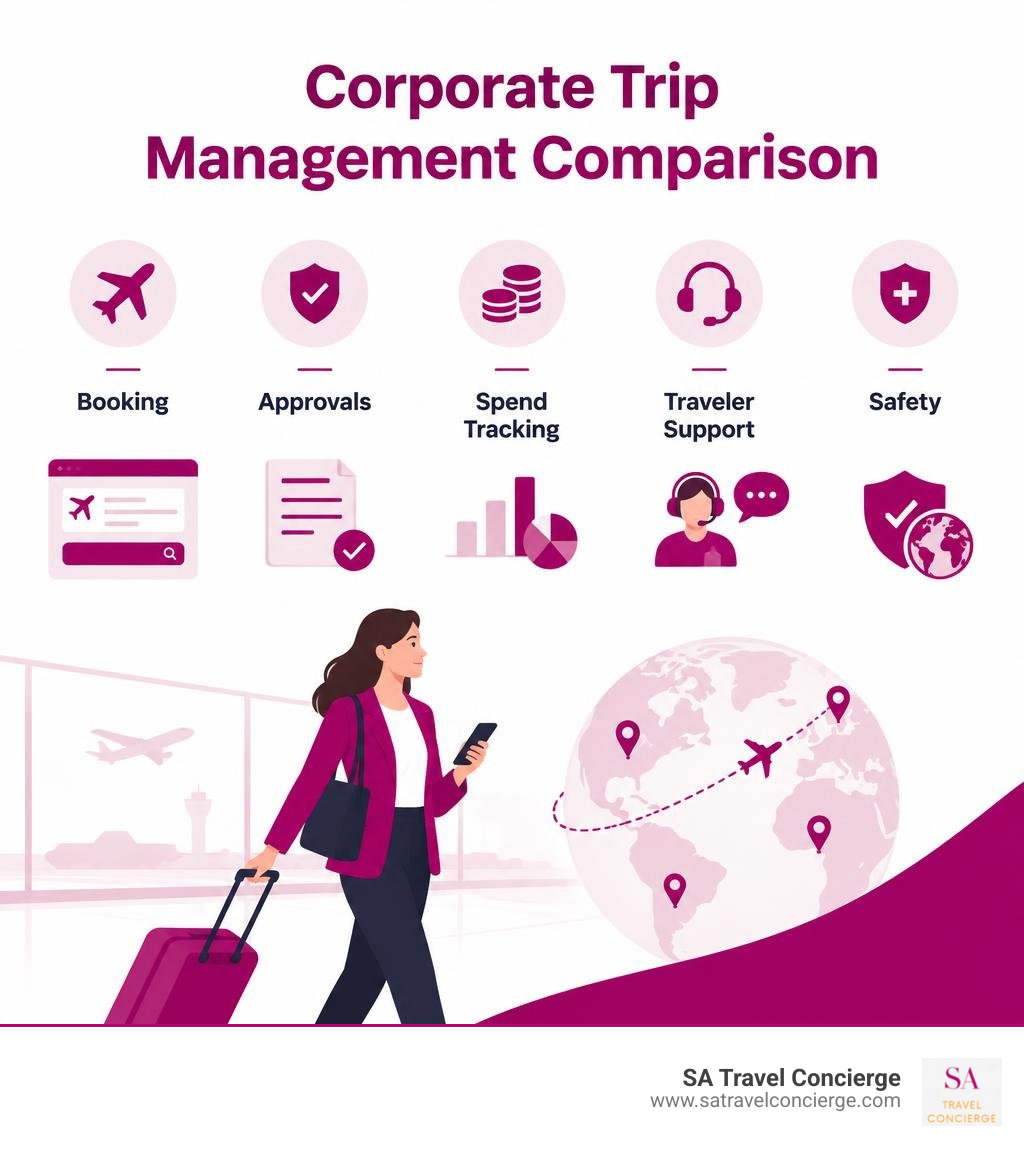
A strong corporate trip management service puts booking, approvals, traveler support, and spending data in one managed process. When comparing options, look beyond the booking tool: the best fit should match your travelers' need for speed and flexibility with your company's needs for cost control, policy compliance, and duty of care.
For busy executives and teams, the key question is simple: Do you need a self-service platform, a high-touch travel specialist, or both? Software can make routine reservations and approvals faster. A concierge-led service adds human help for complex routes, VIP preferences, changes, and urgent issues.
This guide reviews leading corporate booking platforms and specialist service models so you can compare the factors that matter most:
- Booking and policy controls: Can travelers book quickly while staying within approved limits?
- Cost and billing: Are rates, trip costs, invoices, and cost codes visible in one place?
- Support and safety: Is reliable help available when flights change or an emergency occurs?
- Service level: Will your travelers have a dedicated expert for complex, high-stakes trips?
The right choice reduces admin work without making travel feel impersonal or restrictive.
Core Features of a Modern Corporate Trip Management Service
Managing company itineraries without a unified system often leads to rogue bookings, messy expense reports, and zero visibility into where employees are during severe weather or flight disruptions. A modern corporate travel program replaces these scattered workflows with an integrated infrastructure that balances team autonomy with administrative oversight.
Whether your organization manages travel for executives in New York City and Boston or coordinates teams across Los Angeles, Chicago, and Miami, modern travel programs rely on several fundamental pillars. Exploring our comprehensive travel services shows how structured logistics transform fragmented corporate travel into a seamless workflow.
Automated Policy Enforcement and Approvals
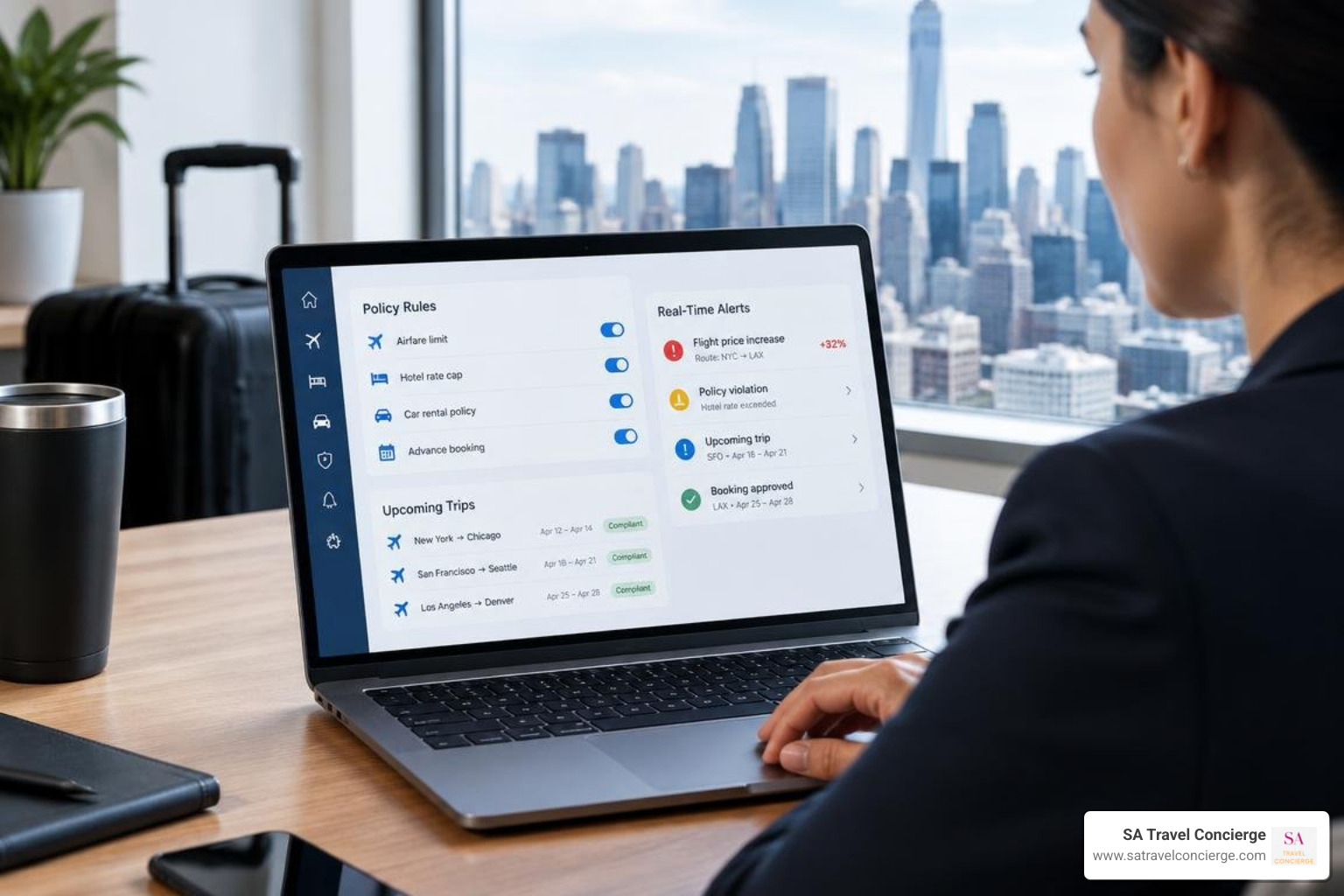
One of the most persistent challenges for finance teams is enforcing travel guidelines after an employee has already purchased a non-refundable, over-budget ticket. Modern booking engines solve this by building policy controls directly into the search results.
Instead of policing receipts post-trip, dynamic platforms apply:
- Rate caps: Search filters automatically restrict flight classes or hotel nightly rates based on employee tier, city tier (e.g., San Francisco vs. Scottsdale), and booking window.
- Out-of-policy flags: If an employee selects an itinerary that exceeds predetermined parameters, the system prompts them to choose an approved alternative or supply a business justification.
- Single-click mobile approvals: Managers receive instant notifications via email or mobile app, allowing them to review and approve itineraries in seconds.
- Backup approver routing: When a primary manager is out of the office or unavailable, requests automatically route to a secondary approver to prevent ticket price increases while waiting for sign-off.
When travel parameters are automated, organizations regularly achieve a 94% policy compliance rate while reducing average booking and approval times down to just 5 minutes.
Spend Visibility and Consolidated Invoicing
Chasing paper receipts and matching credit card statements at month-end drains dozens of administrative hours. Advanced corporate travel programs streamline accounting by consolidating spend into centralized billing accounts.
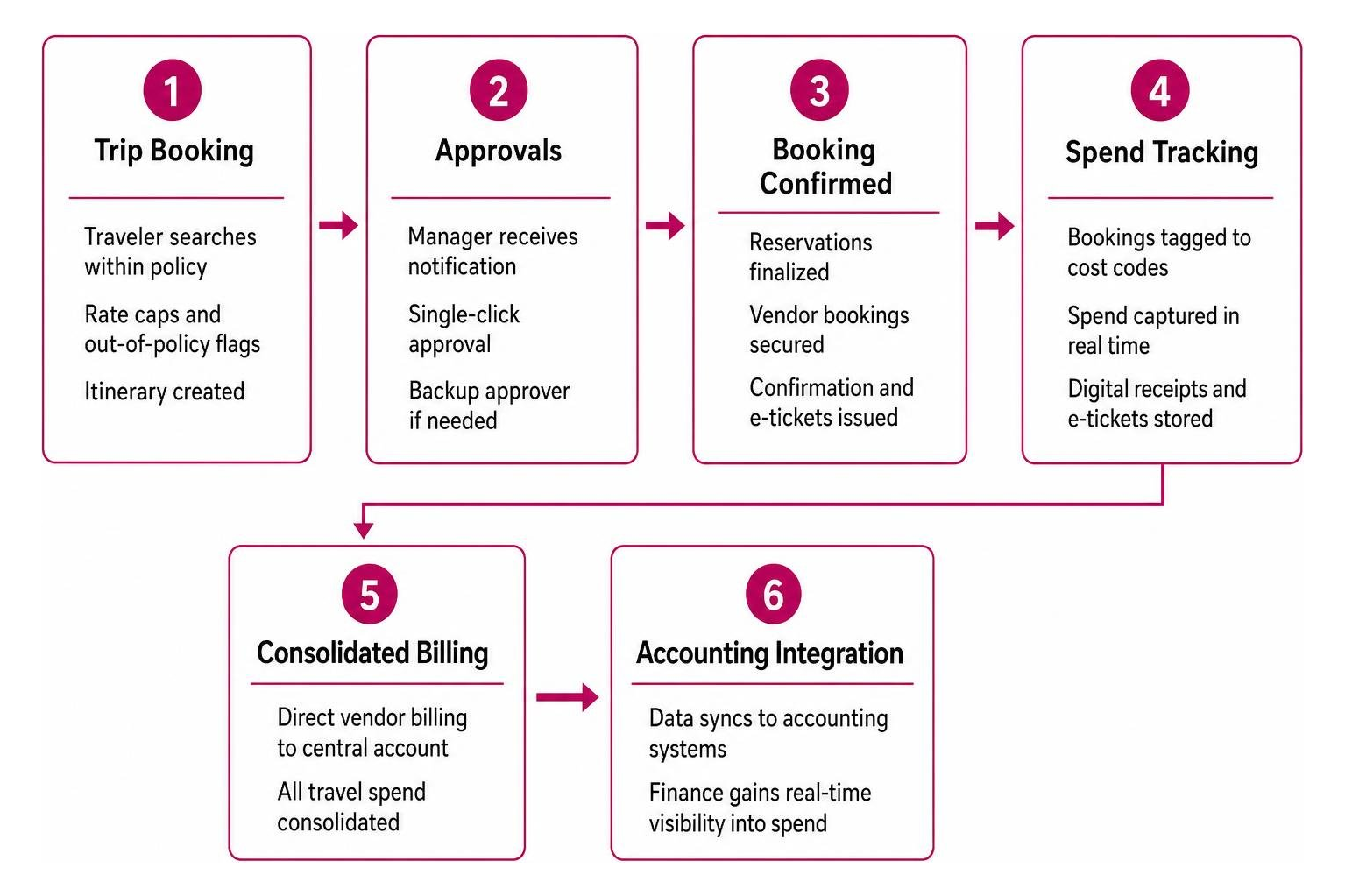
- Direct vendor billing: Central payment profiles eliminate the need for employees to use personal cards or submit individual hotel reimbursement forms.
- Cost code tagging: Every flight, hotel, and rental car is tagged to specific project codes, department numbers, or client billing codes at the moment of reservation.
- Automated receipt capture: Digital folios and e-tickets sync immediately with enterprise accounting systems (such as QuickBooks, NetSuite, and ERP software), giving finance leaders real-time visibility into active budgets.
Comparing Travel Management Solutions: Tech Platforms vs. Concierge Specialists
Every organization approaches corporate logistics differently depending on company size, trip complexity, and executive expectations. Some teams only need self-guided software for point-to-point domestic flights, while others require high-touch human expertise for VIP itineraries, multi-city international tours, and board meetings. Understanding the travel management landscape helps clarify which model fits your organization.
| Feature / Capability | Self-Service SaaS Platforms | Dedicated Concierge Specialists |
|---|---|---|
| Primary Booking Method | Employee self-booking via web/mobile app | Dedicated travel designer handles all logistics |
| Implementation Speed | Under 15 minutes to 6 weeks | Immediate onboarding with tailored profile setup |
| Complex Route Handling | Standard multi-city search algorithms | Expert human curation for optimal layovers & transfers |
| Policy Compliance | Automated algorithmic filters | Personalized itinerary design built directly around policy |
| Disruption Management | Chatbots & standard call queues | Proactive rebooking, direct agent access, 24/7 care |
| Admin Time Savings | Up to 40 hours saved per week per team | Complete offloading of trip research, booking, & changes |
| Best Suited For | High-volume, routine domestic crew travel | Executives, VIPs, complex itineraries, board retreats |
Evaluating the Self-Service Corporate Trip Management Service Model
Self-service platforms focus entirely on software automation. These tools allow employees to log in, search pre-negotiated airline and hotel inventories, and complete their own reservations within pre-set corporate guardrails.
This model is especially appealing to fast-scaling companies that want no-contract, software-as-a-service (SaaS) structures with minimal setup friction. Travel managers can set budget thresholds once, issue virtual payment cards with hard spending caps, and review consolidated monthly statements. While self-service software handles routine domestic point-to-point flights effectively, it places the burden of research, seat selection, and disruption troubleshooting entirely on the traveler or internal travel coordinator.
The High-Touch Corporate Trip Management Service Specialist Approach
For leadership teams in major commercial hubs like Beverly Hills, Newport Beach, Houston, and Seattle, business trips rarely consist of simple out-and-back flights. High-stakes travel often involves multi-leg international connections, private ground transfers, specific hotel room amenities for executive productivity, and strict schedule tolerances.
This is where a bespoke concierge approach excels:
- White-glove curation: Travel specialists handle every detail—from securing preferred hotel room blocks to organizing private meeting spaces and tailored ground transportation.
- Proactive disruption mitigation: When flights are delayed or canceled, dedicated specialists actively monitor itineraries, rebooking connections and adjusting hotel arrivals before the traveler even lands.
- Customized traveler profiles: Individual seat preferences, loyalty program numbers, dietary requirements, and specific airline routing preferences are permanently maintained and executed without repetitive data entry.
If your executive team requires personalized planning and complete relief from logistical overhead, consider contacting our team to design a tailored travel management framework.
Key Strategies to Maximize ROI and Reduce Corporate Travel Spend
Business travel typically accounts for 10% to 15% of an organization's controllable operating budget. Optimizing this spend requires combining negotiated corporate rates, intelligent technology, and active ticket management.

Leveraging New Distribution Capability (NDC) & Pre-Negotiated Rates
Modern travel platforms tap directly into airline NDC feeds and closed-user-group hotel rates. Bypassing traditional global distribution markups unlocks exclusive room discounts and bundled amenity pricing (such as complimentary Wi-Fi, flexible check-in, and breakfast), driving average travel spend savings of 13.4% to 26% compared to open-market consumer sites.Predictive Fare Forecasting
Airfare pricing fluctuates continuously based on yield management algorithms. Advanced forecasting tools analyze historical pricing patterns and seat inventory trends, advising travel managers whether to lock in a fare immediately or wait for an anticipated price drop.Flexible Cancellation Protection and Unused Ticket Recovery
Meeting dates shift, deals close early, and conferences get rescheduled. In an unmanaged travel environment, non-refundable tickets and change penalties lead to massive financial waste. Using flexible cancellation protection plans and automated unused ticket tracking ensures that credit balances are cataloged and automatically applied to future employee bookings before they expire.
Evaluating Safety, Risk Management, and Traveler Support Protocols
Corporate governance extends beyond budgets and balance sheets; employers hold a legal and ethical duty of care to protect traveling personnel. When severe weather hits Chicago, transit strikes disrupt Washington, DC, or unexpected events unfold abroad, businesses must know where their personnel are and how to assist them instantly.
Essential Duty-of-Care Safeguards
- Real-time traveler tracking: Centralized live dashboards pinpoint traveler locations across international flights, regional trains, and hotel properties worldwide.
- Automated security alerts: System notifications keep traveling employees informed of airport security delays, geopolitical developments, and severe meteorological events in real time.
- State Department & STEP integration: For international assignments, proactive registration through the U.S. Smart Traveler Enrollment Program (STEP) connects travelers directly with local embassy resources.
- Rapid emergency response times: In a travel crisis, long hold times are unacceptable. While the broader travel industry averages 30-minute support wait times, premium management programs maintain 24/7 emergency response desks that answer urgent inquiries in under 90 seconds.
Frequently Asked Questions About Business Travel Management
What is corporate travel management and why do growing companies need it?
Corporate travel management is the strategic coordination of an organization's business travel operations, encompassing booking tools, rate negotiation, policy enforcement, expense tracking, and emergency traveler support.
Growing companies need managed travel because unmanaged booking creates significant financial leaks, administrative bottlenecks, and duty-of-care vulnerabilities. A centralized system provides clear spend visibility, cuts booking times, guarantees support during travel disruptions, and ensures company-wide policy compliance.
How can companies measure the success of their corporate travel program?
Evaluating the performance of a corporate travel program involves tracking several key performance indicators (KPIs):
- Adoption rate: The percentage of company-wide bookings processed through approved channels versus unmanaged consumer booking sites.
- Policy compliance rate: The proportion of reservations made within set budget limits, room-rate caps, and advance-purchase windows (top-tier programs consistently hit 90%+).
- Cost savings vs. open market: Realized savings achieved through negotiated corporate discounts, NDC fares, and avoided modification fees.
- Traveler satisfaction and support resolution: Internal feedback scores measuring how quickly support desks resolve disruptions, change requests, and emergency rebookings.
How does corporate travel software simplify expense reconciliation?
Managed travel tools eliminate manual expense reports by connecting booking engines directly to accounting software. When an employee reserves a flight or hotel, the system logs the transaction, applies relevant client or department billing codes, and generates a centralized electronic invoice. Digital folios and receipts are archived automatically, removing the need for employees to save paper receipts or submit manual expense claims for reimbursement.
Conclusion
An optimized corporate travel strategy balances automated efficiency with tailored human support. While automated software easily manages routine bookings and policy guardrails, executive travel and complex international itineraries demand the precision, flexibility, and proactive care of experienced travel specialists.
Consolidating your organization's travel operations eliminates administrative waste, protects bottom-line profitability, and ensures your team is supported wherever business takes them. Discover how our tailored business travel solutions elevate corporate journeys across our offices in New York, Los Angeles, Miami, Chicago, and beyond.