
Fly Boutique and Experience the Charm of an All Business Class Airline
Why an All Business Class Airline Is Worth Considering
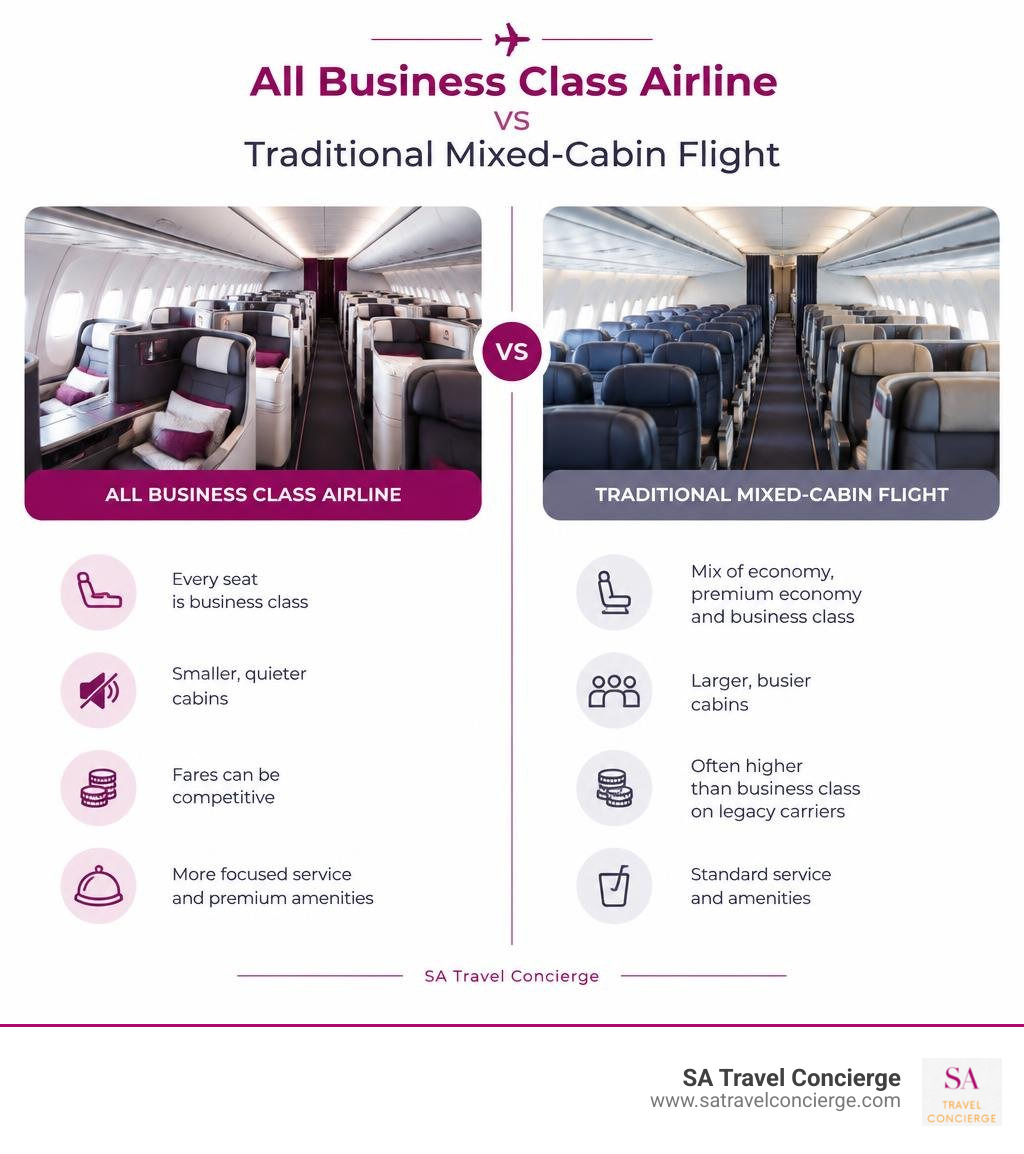
An all business class airline puts every passenger in a premium seat. Today, the dedicated choices are limited, with boutique carriers such as La Compagnie serving select transatlantic routes and beOnd focusing on luxury leisure routes to the Maldives.
For travelers who value time, space, and a smoother trip, the appeal is simple:
- Every seat is business class, usually with lie-flat comfort on long-haul flights.
- Cabins are smaller and quieter than a typical mixed-cabin aircraft.
- Fares can be competitive with legacy-airline business class, especially on select routes.
- Service is more focused, with premium dining, bedding, power, Wi-Fi, and priority airport benefits often included.
This is not private aviation, and the trade-off is important: these airlines have small fleets and narrow route networks. But on the right nonstop route, they can deliver much of the calm, personal feel of a private flight at a commercial-airfare price.
What Is an All Business Class Airline and How Does It Differ from Legacy Carriers?
When most of us step onto a standard commercial jet, we navigate past rows of seats, crowded overhead bins, and distinct curtain dividers separating cabin tiers. An all-business boutique airline flips that script entirely. By stripping away economy and premium economy seating, the carrier dedicates 100% of its cabin space to premium travelers.
The primary difference lies in passenger density and cabin environment. Legacy airlines often fly wide-body aircraft carrying between 250 and 400 passengers across three or four separate classes. In contrast, an all-business operator uses single-aisle, narrow-body aircraft configured for only 50 to 76 guests.
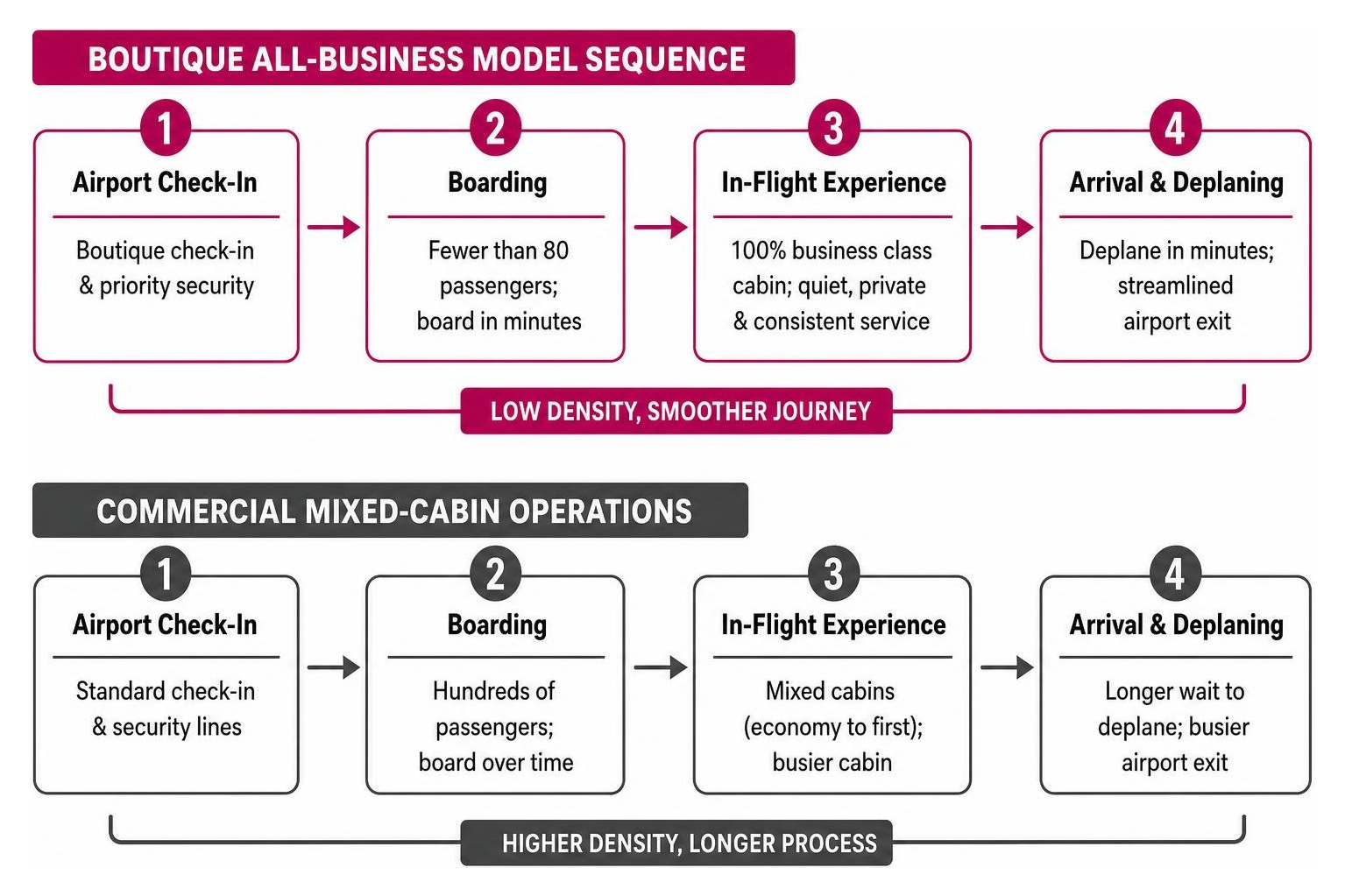
This low-density approach transforms the entire journey:
- Effortless Boarding and Deplaning: With fewer than 80 passengers, boarding takes minutes rather than nearly an hour.
- Quiet, Private Ambience: Without hundreds of passengers walking through aisles, the cabin remains peaceful throughout the flight.
- Dedicated Crew Attention: Flight attendants focus exclusively on a single service standard, ensuring consistent culinary delivery and personalized attention.
- Streamlined Airport Experience: Boutique check-in counters and priority security access minimize ground transit time.
Understanding the All Business Class Airline Fleet Model
The operational backbone of today’s boutique airlines is the modern, highly efficient narrow-body jet. Historically, operating long-haul routes required massive twin-aisle aircraft that were difficult to fill exclusively with premium travelers. Today’s technology allows carriers like La Compagnie to utilize advanced twin-engine jets such as the Airbus A321neo.
La Compagnie configures its Airbus A321neo jets with just 76 lie-flat seats arranged in a spacious 2x2 layout. Similarly, boutique luxury carrier beOnd operates low-density Airbus aircraft, with configurations featuring as few as 44 to 68 lie-flat seats. These modern aircraft consume roughly 20% to 30% less fuel than previous-generation jets, allowing boutique airlines to significantly reduce per-passenger carbon emissions while maintaining lower operating overheads.
Legacy Flagship Business Class vs Boutique Single-Cabin Travel
Legacy carriers offer exceptional premium products. Airlines like Qatar Airways with their Qsuite, Cathay Pacific, Lufthansa, and Finnair have set high standards for premium travel. In North America, the American Airlines Dreamliner business class offers lie-flat seats on wide-body Boeing 787-8 and 787-9 aircraft.
However, the experience on an all-business-class boutique flight offers distinct operational and aesthetic differences:
| Feature / Metric | Dedicated Boutique Carrier (e.g., La Compagnie) | Major Global Legacy Carrier |
|---|---|---|
| Cabin Layout | Single-cabin; 100% lie-flat business seats | Multi-cabin (First, Business, Premium Economy, Economy) |
| Total Passengers on Board | 56 – 76 passengers | 200 – 400+ passengers |
| Boarding / Deplaning Time | ~10 to 15 minutes | ~35 to 55 minutes |
| Cabin Atmosphere | Intimate, private-jet feel, exceptionally quiet | Dynamic, active, higher foot traffic |
| Route Network | Point-to-point niche routes | Global hub-and-spoke connectivity |
| Flight Frequencies | 1–2 daily flights per route | Multiple daily frequencies across alliances |
| Pricing Predictability | Highly transparent, often 30–50% below legacy fares | Dynamic pricing influenced by corporate hub volume |
While legacy carriers excel in flight frequencies and vast alliance networks, boutique single-cabin operators provide an exclusive atmosphere that avoids the bustle of mass-transit aviation.
Current Routes, Pricing, and In-Flight Amenities
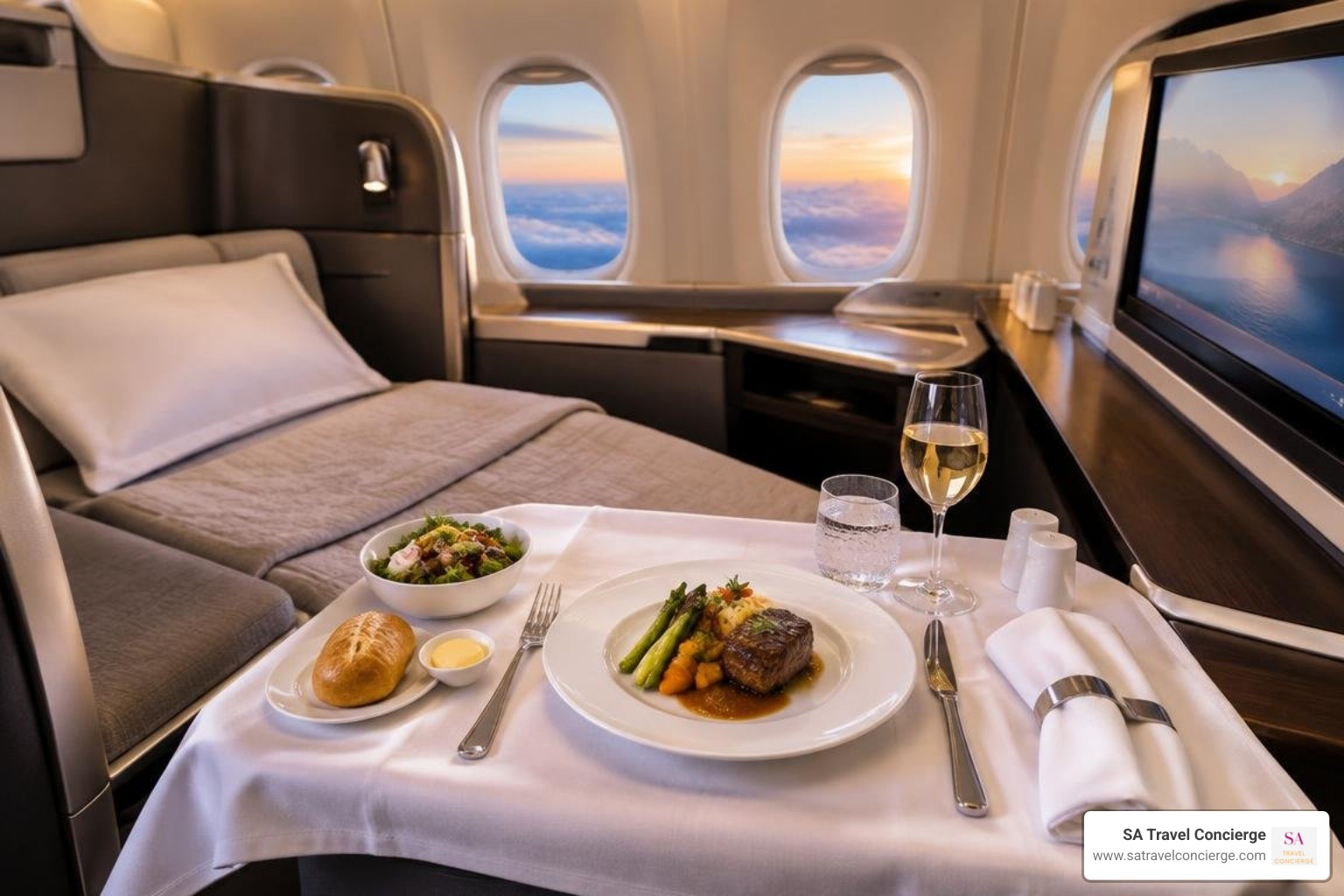
Whether you are coordinating an executive trip from New York City or arranging high-end leisure travel to European cultural hubs, boutique carriers offer transparent pricing alongside luxury amenities.
Top Global Destinations and Key Routes in 2026
Boutique carriers avoid standard multi-hub networks, focusing instead on high-demand point-to-point corridors:
- Transatlantic Corridors (La Compagnie): Nonstop service connecting Newark Liberty International Airport (EWR) directly to Paris Orly (ORY), Milan Malpensa (MXP), and Nice Côte d'Azur (NCE). Seasonal routes also connect North America with vibrant European business centers like Düsseldorf.
- Luxury Leisure Corridors (beOnd): Specializing in direct connections between major European/Middle Eastern cities (such as Milan, Zurich, and Dubai) and Velana International Airport (MLE) in Male, Maldives.
- Emerging Domestic & Regional Corridors: New luxury ventures like Beond America have announced plans to launch low-density 56- to 68-seat Airbus A320/A321 aircraft linking key luxury gateways in the U.S. to Caribbean and transcontinental resort destinations.
Choosing the Right All Business Class Airline for Transatlantic Travel
Boutique single-cabin carriers provide considerable value compared to traditional legacy business class fares on competitive routes:
- New York (EWR) to Milan (MXP): Roundtrip business fares on La Compagnie typically average around $3,059. Comparable legacy business class tickets on British Airways, Air France, Emirates, or United frequently range between $3,548 and $5,237.
- New York (EWR) to Paris (ORY): Fares on boutique all-business routes regularly start around $2,000 to $2,400 roundtrip, saving travelers 30% to 50% compared to legacy competitors.
- Milan (MXP) to Maldives (MLE): beOnd offers roundtrip lie-flat journeys starting around €1,895 (~$2,194 USD), delivering an accessible premium leisure gateway.
Onboard, boutique carriers deliver curated comforts designed for rest and productivity:
- Ergonomic Lie-Flat Seats: Fully flat beds stretching up to 75–78 inches, paired with plush bedding, anti-allergenic pillows, and quilted duvets.
- Gourmet Culinary Experiences: Multi-course menus curated in partnership with renowned European and Michelin-starred chefs, accompanied by selected organic wines and vintage champagnes.
- High-Speed Connectivity & Entertainment: Complimentary unlimited high-speed Wi-Fi, universal power and USB outlets at every seat, and noise-canceling headsets paired with modern in-flight entertainment screens.
- Effortless Ground Handling: Dedicated check-in zones, expedited security clearance (including TSA PreCheck and Fast Track in Europe), and comprehensive lounge access before departure.
The Evolution, Past Pitfalls, and Future Outlook of Boutique Flying
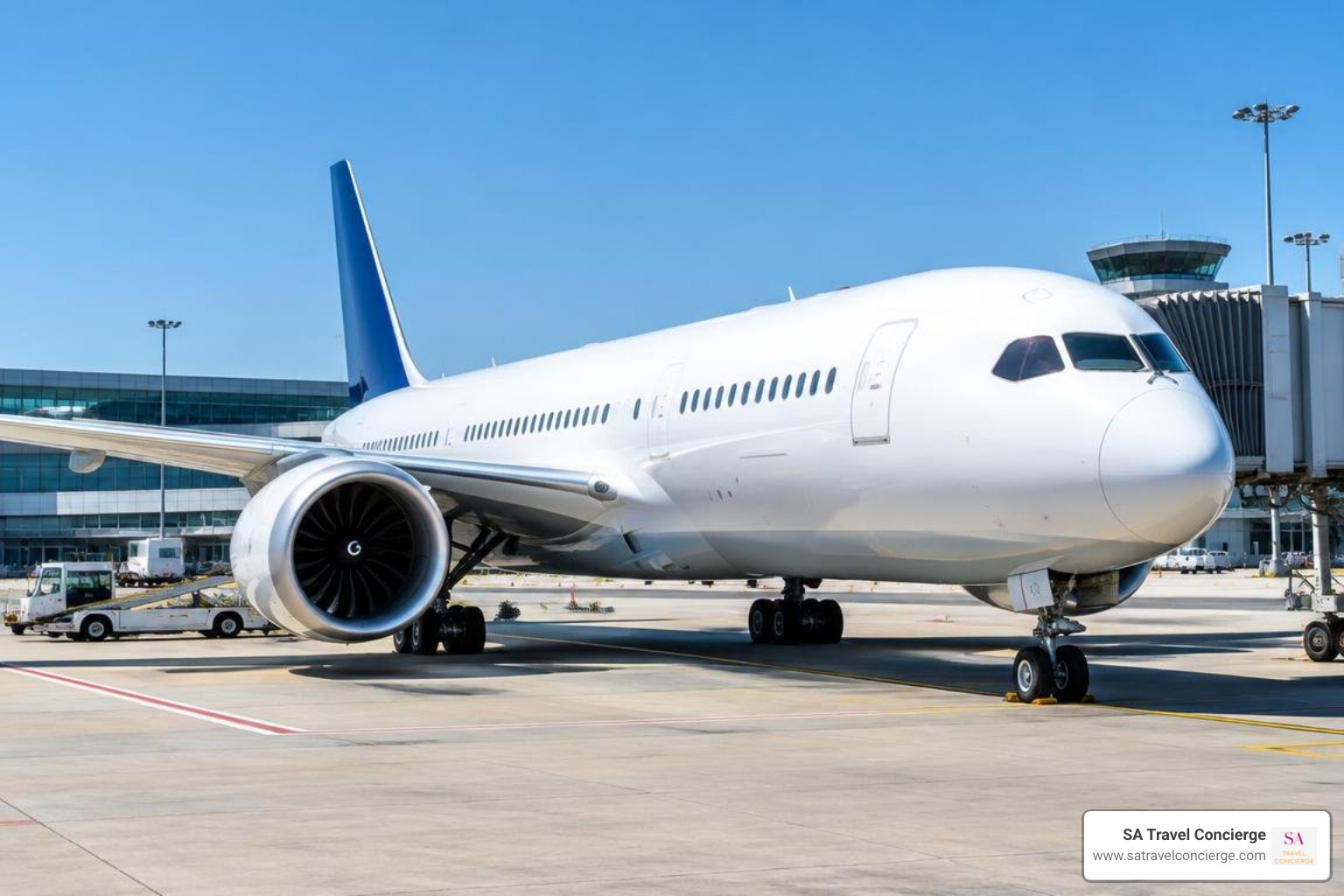
The concept of dedicated all-business-class flying has undergone significant transformation over the past three decades. In our industry insights on our travel blog, we often examine how aviation economics dictate travel trends.
Between 2004 and 2008, early boutique carriers such as MAXjet, Silverjet, and Eos Airlines launched all-premium transcontinental flights. However, these pioneers relied on older, fuel-thirsty Boeing 757s and 767s. When oil prices spiked beyond $100 a barrel in 2008 alongside the global financial crisis, their high operating costs made those businesses unsustainable.
Today’s operators have built resilience through specific operational strategies:
- Ultra-Efficient Aircraft: The Airbus A321neo reduces operating and fuel costs by up to 30% compared to previous generations, insulating airlines from fuel volatility.
- Right-Sized Capacity: By capping cabin sizes at 68 to 76 seats, boutique carriers can maintain high load factors year-round.
- Strategic Secondary Airports: Utilizing convenient airports such as Paris Orly reduces landing fees and gate delays compared to larger congested hubs.
While boutique fleets remain small (often 2 to 4 aircraft per carrier), operators manage schedule reliability through strategic partnerships, charter support agreements, and clear passenger protection protocols.
Frequently Asked Questions About All-Business Aviation
Are all-business-class flights cheaper than traditional business class?
Yes, in many cases. Dedicated boutique carriers typically offer roundtrip transatlantic tickets between $2,000 and $3,100, which is often 30% to 50% lower than the unrestricted business class fares charged by legacy network carriers on identical routes.
What happens if an all-business-class flight is delayed or canceled?
Because boutique carriers operate smaller fleets without massive hourly hub operations, unexpected mechanical delays require proactive resolution. Modern boutique airlines maintain interline rebooking agreements, reroute passengers via partner commercial airlines when necessary, or provide comfortable hotel and ground accommodations in accordance with international passenger protection regulations.
Which carriers currently offer dedicated all-business-class flights?
As of 2026, the primary dedicated carriers operating pure single-cabin all-business scheduled flights are La Compagnie (operating transatlantic routes between New York/Newark and Paris, Milan, and Nice) and beOnd (operating luxury leisure flights between Europe/Middle East and the Maldives). Emerging luxury operators like Beond America are actively working to introduce similar single-cabin narrow-body models within the Americas.
Conclusion
Choosing a boutique, single-cabin airline delivers an intimate, relaxed, and elevated journey without the staggering price tag of private aviation. With quiet cabins, thoughtful dining, and lie-flat comfort, boutique flying makes crossing oceans and exploring dream destinations a rejuvenating experience.
At SA Travel Concierge, we specialize in high-touch, beautifully curated itineraries for executive business travel and relaxing holidays alike. From selecting the ideal boutique flight to securing luxury hotel accommodations, private transfers, and bespoke concierge requests, we manage every detail so you can travel completely hassle-free.
Contact our expert team today to plan your next seamless journey.